- Home
- >
News
Ensure the longevity of your Graphite Curved Crystal Monochromator with proper maintenance. Key steps: store in a dry environment, handle gently, and clean regularly. Adhering to these guidelines and the manufacturer's instructions guarantees reliable performance and extends equipment life.
Multifunctional X-ray diffractometer for material science. Performs phase, crystal, thin film, micro-area, and stress analysis. Key advantages: high-precision measurement, stable control, programmable operation, innovative non-concentric goniometer design, and configurable accessories. An indispensable tool for researchers.
A 2D X-ray diffractometer requires strict daily maintenance to ensure accuracy. Key tasks include managing the operating environment (temperature 15–25°C, humidity 20–80%, dust and vibration-free). Regular cleaning of the sample holder and internal components is essential, alongside maintaining the recirculating cooling water system to prevent blockages. X-ray tubes need proper conditioning after extended inactivity and must be set to standby or shut down appropriately. The computer workstation requires data backup, and strict safety precautions, such as avoiding contact with beryllium windows and never bypassing safety interlocks, are critical.
X-ray Absorption Spectrometer (XAS) analyzes material structure via X-ray interaction. It precisely tunes energy to excite specific elements, providing data on valence states and electronic structure. Recent advances include SuperXAFS series with synchrotron-comparable data and tabletop systems for lab use. XAS is widely applied in materials science, chemistry, biology, and medicine to study crystal structures, reaction mechanisms, and biomacromolecules.
Improving crystal orientator performance requires technological upgrades (advanced scanning, enhanced hardware/software), proper sample preparation, regular calibration and maintenance, professional operator training with standardized procedures, and continued R&D investment for innovation.
Two-dimensional X-ray diffractometer enables precise analysis of crystal structure, phase composition, crystallinity, grain size, and defects across metals, ceramics, nanomaterials, polymers, and more. It offers rapid acquisition, high resolution, and non-destructive testing, supporting material development, process optimization, and performance enhancement. Its versatility and multi-mode capabilities make it indispensable in materials science research.
To obtain high-quality XRD data, maintain and calibrate the instrument. Select optimal parameters (wavelength, speed) based on your sample. Prepare a clean, flat, and uniform sample. Finally, use proper software for accurate data analysis.
Rotating sample stages ensure precision in scientific and industrial processes. Key maintenance practices include: 1) Regular cleaning with a soft cloth and safe solvents to prevent contamination. 2) Lubrication of bearings and gears to reduce wear. 3) Tightening fasteners and adjusting components as needed. 4) Corrosion prevention in harsh environments. 5) Avoiding overloads and impacts. 6) Proper storage and transport with protective measures. 7) Conducting routine inspections and keeping maintenance records to address issues early and ensure longevity.
Accuracy of X-ray Crystal Analysis Results are affected by: X-ray tube & detector (intensity, noise, resolution), Sample (uniformity, defects, surface), and Environment (thermal drift, humidity, magnetic fields). Controlling these variables is essential for precise structural data.
Benchtop XRD: A vital nanotechnology tool for atomic-scale analysis. It decodes crystal structure, phase composition, and grain size via diffraction patterns. Essential for understanding nano-properties, controlling synthesis, and designing composites, its enhanced resolution powers research and innovation across pharmaceuticals, energy, and electronics.
High-Resolution X-ray Absorption Spectroscopy is a cutting-edge technique for atomic-scale analysis of materials' electronic and chemical states. The core challenge is achieving <1 eV energy resolution with high signal-to-noise. We overcome this by combining high-harmonic rejection mirrors with channel-cut monochromators for optimal brightness and resolution, integrating ultra-low-noise silicon drift detectors with real-time calibration for stability, and offering modular in-situ chambers for fast, efficient measurements under realistic conditions. Our spectrometers enable groundbreaking research in catalysis, quantum materials, and biochemistry.
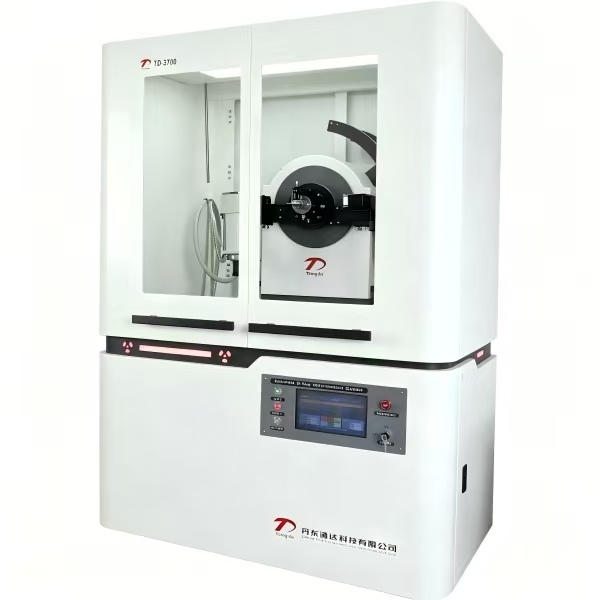
The TD-3700 High-Resolution X-Ray Diffractometer integrates a high-speed array detector, enhancing signal intensity by tens to hundreds of times. It enables rapid phase, stress, and structural analysis in transmission/reflection modes, supporting industries from electronics to materials research with high efficiency and accuracy.